Tickshift vs Sudoku: two logic puzzles that train different kinds of thinking
Sudoku is about deduction on a fixed grid; Tickshift is about planning lines that move. A side-by-side comparison to help you pick, or enjoy both.

The short comparison
| Sudoku | Tickshift | |
|---|---|---|
| The board | A 9 × 9 grid of digits | A small grid with colored cores and pieces |
| What you do | Write digits that follow row, column and box rules | Place arrows, walls and other pieces, then press RUN |
| How it is solved | Step-by-step elimination | Planning lines that all move at the same time |
| Feedback | You learn about a mistake later | You see every plan run, step by step |
| Key skill | Deduction | Planning, timing and spatial reasoning |
| Session length | Often 10–30 minutes per grid | A level often takes a minute or a few |
| Platform | Everywhere, on paper and apps | iPhone, iPad and iPhone Duo |
What Sudoku trains
Sudoku is pure constraint logic: every row, column and 3 × 3 box holds the digits 1 to 9 once. You remove possibilities until only one remains. It rewards patience and careful bookkeeping, and a well-made grid needs no guessing.
What Tickshift trains
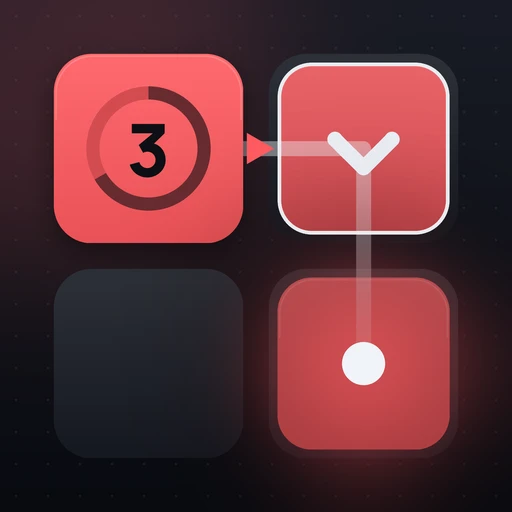
Tickshift has one rule for every line: keep going straight; if blocked, turn right; if still blocked, turn left. All lines grow at once, one cell per step, and every painted cell becomes a wall for the others. You are not filling in answers; you are designing a small machine and predicting how it behaves. That exercises different muscles: thinking a few steps ahead, timing two lines so they don’t collide, and imagining shapes on a grid.
From the game
Each colored core grows a line, one cell per step. You don’t draw the path, you plan it. Try it: press RUN.
- 1Keep going straight.
- 2Blocked? Turn right.
- 3Still blocked? Turn left.
Feedback changes how it feels
In Sudoku, a wrong digit can hide for a long time. In Tickshift, you press RUN and see exactly where your plan worked and where two lines met. Rewind, change one piece, and run again. There are no timers and no lives, so experimenting is part of the fun.
Which one should you play?
- Choose Sudoku if you love certainty, long quiet sessions and pen-and-paper style.
- Choose Tickshift if you like puzzles that move, short levels, and the moment a plan clicks.
- Play both if you want variety: one for deduction, one for planning.
Tickshift is free on the App Store, with 500 levels across 20 chapters. Start with how to play Tickshift or see how it compares with other line puzzles.
Questions
Is Tickshift like Sudoku?
Both are logic puzzles with one correct idea per board, but Sudoku is solved by deducing digits on a still grid, while in Tickshift you place pieces and then watch lines grow by a rule. Tickshift is about planning and timing; Sudoku is about elimination.
Which is better for beginners?
Tickshift teaches its whole rule in the first level and shows you the result of every plan by running it, so it is easy to start. Sudoku has simple rules too, but beginners often get stuck without feedback until the grid is wrong.
Do I need math for either game?
No. Sudoku uses digits as symbols, not for arithmetic. Tickshift uses counting at most: each core shows how many cells it will paint.

