Line puzzle games compared: drawing lines vs planning lines that move
Most line puzzle games ask you to draw a path. In Tickshift, lines move on their own by one rule. How the two styles differ, and who each one suits.
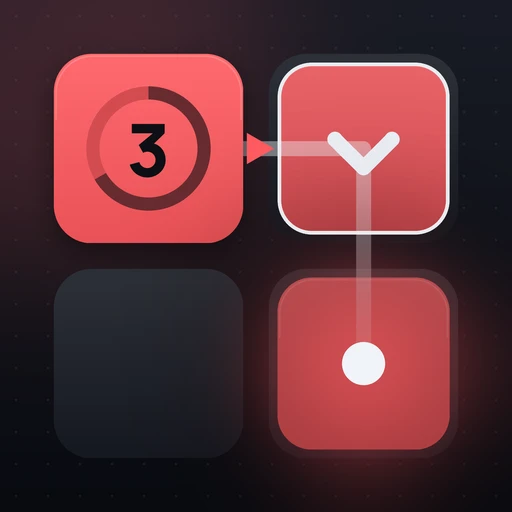

Two ways to play with lines
| Draw-the-path puzzles | Tickshift (plan and run) | |
|---|---|---|
| Who moves the line | You, with your finger | The rule, after you press RUN |
| What you decide | The exact route | Where to put arrows, walls and other pieces |
| Lines at once | Usually one at a time | Up to four, all moving together |
| Main challenge | Finding a path that fits | Predicting turns and timing |
| Mistakes | Erase and redraw | Rewind, change one piece, run again |
Drawing games: route finding
In connect-the-dots and one-stroke puzzles, you see the board, think, and trace. The challenge is spatial: avoid crossing, cover every cell, and don’t paint yourself into a corner. They are relaxing and quick to learn.
Tickshift: route predicting
Tickshift turns the idea around. Each colored core grows a line, one cell per step, and every line follows the same rule: keep going straight; if blocked, turn right; if still blocked, turn left. Your job is to shape the board so that, when everything moves at once, the lines fill every cell without meeting.
Because every painted cell becomes a wall, the lines shape each other. A line that passes early can steer a later one, so order and timing matter as much as direction.
Which style is for you?
- If you like calm tracing and instant control, drawing games are great.
- If you like thinking ahead, small chain reactions and the moment a plan works, try Tickshift.
Tickshift has six pieces (direction, wall, delay, rotator, splitter and portal) that keep changing the puzzle over 500 levels. See every piece explained or the comparison with Sudoku.
Questions
What is a line puzzle game?
A puzzle where you connect or fill a grid with lines or paths. Classic examples ask you to link matching dots or draw one continuous path through every cell.
How is Tickshift different from connect-the-dots line puzzles?
In Tickshift you never draw the line. You place pieces such as arrows and walls, press RUN, and every line grows at the same time following one rule: straight, else right, else left.
Are arrow puzzles and line puzzles the same?
They overlap. Many arrow puzzles use arrows as moves; in Tickshift arrows are pieces that point lines, and the goal is to fill the whole board without collisions.

