Logic puzzle strategy: 7 ways to solve harder Tickshift levels
Seven practical strategies for harder logic puzzles in Tickshift: count the cells, start from the corners, read each turn, and fix one piece at a time.


1. Count before you place
Each core’s number is how many cells it paints. Add them up: together they cover every empty cell of the board. If one area needs eight cells and only one core can reach it, you already know which line has to go there.
2. Start from the corners and dead ends
A corner cell has only two neighbors, and a dead end has one. These are the cells a line can miss most easily, so they decide a lot. Work out which line can reach each corner first, then fit the open middle around those choices.
3. Use the rule to steer
Lines always try straight, then right, then left. That means you can predict a turn without any piece: a line that hits a wall turns right. Place a wall or another line’s trail in the right spot and the rule does the steering for you, which saves your arrows for the turns the rule won’t make.
4. Watch the timing
All lines move at the same speed, one cell per step, from the same moment. Two lines that would reach one cell on the same step collide. Count steps from each core to the crossing: if the numbers match, change one path or use a delay so one line arrives first.
5. Think in trails
Every painted cell becomes a wall. A line that passes early leaves a trail that the later lines bounce off, so the order in which lines arrive matters as much as where they go. Sometimes the right move is to let one line run long first, so its trail shapes the others.
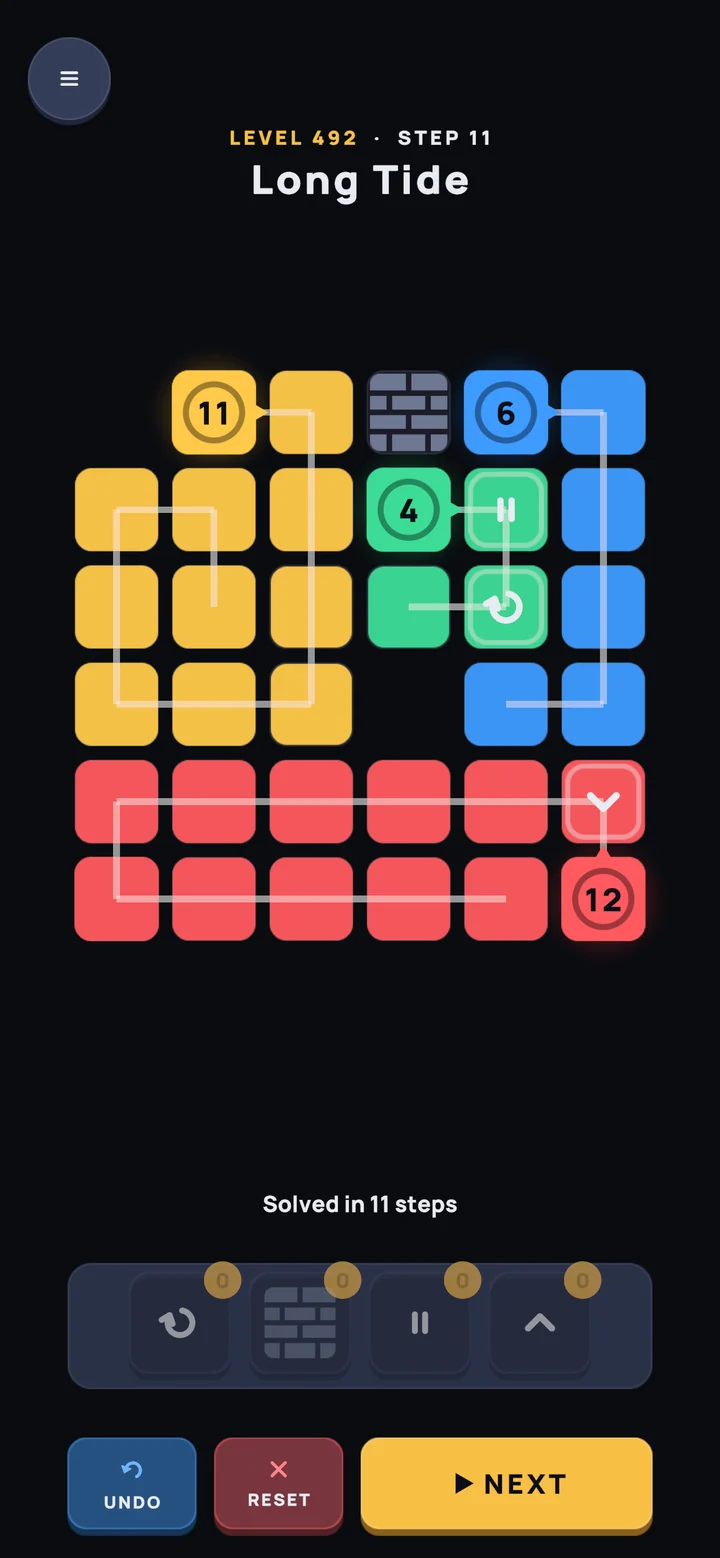

6. Change one piece at a time
After a failed run, rewind and change a single piece. If you move three things, you won’t know which one fixed or broke the level. Short runs and small changes teach you the board fastest.
7. Take a break
There are no timers and no lives, so nothing is lost by stepping away. A fresh look often finds the turn you kept missing.
| Problem | First thing to check |
|---|---|
| Two lines collide | Count steps from each core to the crossing cell |
| A corner stays empty | Which line can reach it, and what turns it away |
| A line is trapped early | The trail of a line that passed before it |
| The board fills but one core is unfinished | The core’s number against the cells you left it |
Still learning the pieces? Read every piece explained, or go back to how to play Tickshift.
Questions
What is the best first step on a hard level?
Count. Add up the numbers on the cores and compare them with the number of empty cells. Then look at the corners and dead ends: they have the fewest ways to be filled.
What should I do after a collision?
Note the exact cell and step where the two lines met, then change only the piece that decides one of those two paths. Changing several pieces at once hides what worked.
Are all levels solvable?
Yes. Every one of the 500 levels was checked to be solvable.

